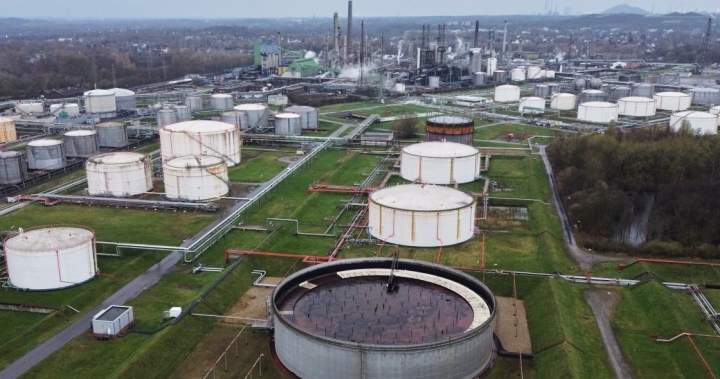
Canada and dozens of other countries have agreed to release 400 million barrels of oil from their strategic reserves as Iran’s war threatens global supplies.
The International Energy Agency (IEA), which consists of Canada and 31 other member countries, made the announcement in a release on Wednesday after saying that the meeting was held “to assess market conditions amid conflict in the Middle East and consider options to address supply disruptions.”
The IEA said this was the sixth time a coordinated stock release had been carried out since the organization was founded in 1974.
“The oil market challenges we face are of an unprecedented scale, which is why I am very pleased that IEA Member States have responded with emergency collective action on an unprecedented scale,” said IEA Executive Director Fatih Birol in the release.
“Oil markets are global so responses to major disruptions must also be global. Energy security is a core mandate of the IEA, and I am pleased that IEA Members are showing strong solidarity in taking decisive action together.”

Get daily National news
Get Canada’s daily news stories delivered to your inbox so you never miss the day’s top stories.
Iran has blocked the Strait of Hormuz shipping lanes by threatening any ships that try to pass through the narrow channel that separates the Persian Gulf from global shipping lanes. About 20 to 25 percent of the world’s oil supply depends on the strait being open to shipping traffic.

According to the IEA, its members have emergency reserves of more than 1.2 billion barrels of oil, with an additional 600 million in industrial reserves that are government obligations.
“The conflict in the Middle East that began on February 28 2026 has hampered the flow of oil through the Strait of Hormuz, with export volumes of crude oil and refined products currently less than 10 percent of pre-conflict levels,” the IEA said in a release.
“This forced operators across the region to close or limit large amounts of production.”
Earlier on Wednesday, Iran’s military spokesman warned that global oil prices could reach US$200 per barrel if the conflict continues.
Oil prices hit nearly $120 a barrel on Monday, before dropping slightly. At the time of publication, the price was just under $90, and up from around $64 in the days before the conflict began.
On Monday, Finance Minister François-Philippe Champagne told reporters there would be “further consultations” before taking action to calm oil market concerns, including releasing strategic oil reserves.
“It’s very volatile,” he said. “I mean, what we’re all making sure of is that there will be enough stock, of course, to meet demand.”
The IEA statement said it would “continue to closely monitor global oil and gas markets” and provide further recommendations to governments within its organization if necessary.
© 2026 Global News, a division of Corus Entertainment Inc.
PakarPBN
A Private Blog Network (PBN) is a collection of websites that are controlled by a single individual or organization and used primarily to build backlinks to a “money site” in order to influence its ranking in search engines such as Google. The core idea behind a PBN is based on the importance of backlinks in Google’s ranking algorithm. Since Google views backlinks as signals of authority and trust, some website owners attempt to artificially create these signals through a controlled network of sites.
In a typical PBN setup, the owner acquires expired or aged domains that already have existing authority, backlinks, and history. These domains are rebuilt with new content and hosted separately, often using different IP addresses, hosting providers, themes, and ownership details to make them appear unrelated. Within the content published on these sites, links are strategically placed that point to the main website the owner wants to rank higher. By doing this, the owner attempts to pass link equity (also known as “link juice”) from the PBN sites to the target website.
The purpose of a PBN is to give the impression that the target website is naturally earning links from multiple independent sources. If done effectively, this can temporarily improve keyword rankings, increase organic visibility, and drive more traffic from search results.